Sunday, January 23, 2011

Wednesday, January 5, 2011
The Average Person Spends 24 Years of Their Life Asleep
No objections to the grammatical error in the title, please! It's a quotation from "The Joy of Stats", a 1-hour BBC Four program narrated by the Swedish public health expert and statistician Hans Rosling. I had first heard of him when a friend sent me a link to the short video, "200 Countries, 200 Years, 4 Minutes", which turns out to be an excerpt from "The Joy of Stats". If you want to take four minutes of your life to feel much much better about the future of the planet, stop and watch that video now.

While watching this video, it struck me that it would be a great way to address one of my New Year's resolutions for teaching: TEACH MORE STATISTICS.
I teach math to students who don't love math and maybe never will despite my best efforts. Some of them may go on to take calculus in high school or college, or they may study engineering, economics, medicine or some other field that demands high mathematical abilities. But my guess is that some of them will be artists, some will be business owners, some lawyers, some journalists (if that's still a profession in their time), etc. Those professions just don't require a high degree of specialized algebra or calculus knowledge. Yes, it's great for them to develop problem-solving abilities through algebra, geometry and calculus. But honestly, what they need to is to learn stats. That's where we see math everyday.
Here's a challenge for you. Pick up a newspaper and find a random article. Now try to read to the second column of the article without reading a statistic. Good luck. Stats matter. We are constantly confronted with them so that we will be persuaded to believe the arguments and stories put before us. Stats have all the credibility. Especially in today's world of overwhelming amounts of data.
So, my goal is to teach more statistics and maybe even to have students connect statistics (and hence math!) to the things they already care about. Baseball. Basketball. Blockbuster movies. Cell phones. Shopping. Whatever.
Here's where I need some help. What should students learn to do with statistics? We teach them about mean, median, mode, etc. But what about teaching them how to collect data? And deal with organizing messy data from multiple sources that come in at different times?
Do you use statistics in your life? What do you do?
Tuesday, January 4, 2011
Shameless Attempt to Be a Featured Workspace on Lifehacker
I work with students on editing their writing at my desk, but it's often awkward to share the keyboard and mouse. All I want to do is show where the student needs to insert a comma or fix a typo, but it can be disruptive when we they don't understand exactly where I mean.
Also, with some students it is very difficult for them to get their ideas out when they have to write them, although they can give you perfectly clear answers verbally. So sometimes I will type the work for them while they dictate, but then the keyboard is out of their hands and they can't transition into writing for themselves.
I solved this problem by adding an Apple Wiresless Keyboard and Magic Mouse to double up. The installation was easy since both devices work on Bluetooth. The wireless keyboard is much smaller, which is nice since many of my students are so used to their laptop keyboards that they have trouble using the larger standard keyboard. The Magic Mouse has so many extra features like zooming and web browsing that its an upgrade. All of it is so small that it doesn't have to clutter my desk and I can put it all away if I ever really need the desk space.
Today we installed the same devices on the other desks in our office and the response has been good. I just finished watching a teacher and student have a typing race. It will be interesting to see how helpful this is once everyone gets used to the new devices.

Thursday, October 7, 2010
WCYDWT: Fare HIke
Reading the NY Times today I saw a blog post regarding the MTA's vote to raise the price for 30-day and weekly metro passes as well as individual fares. What caught my eye was that the article described one increase (for the 30-day passes) in terms of percent increase. That was all I needed.
Following the Meyer method, I got an image of the article and blacked out the percent increase answer for the students. I asked them to predict what the percent increase could be. We investigated the problem. I demonstrated how to find percent increase, which only a few of the students seemed to have learned before. Then, we checked our answer against a clean copy of the article that I printed later.
Overall, there was some learning and some excitement, but I can't help thinking that I could have done this better. What could I have done differently?
Before:
 After:

Notes for next time:
- Next time black out the answer in Keynote, then print. My students spent a ridiculous amount of time trying to read through the dark splotch that I made with my pen before making copies.
- We tied in our steps for problem solving (Understand, Plan, Answer, Check) a bit too late. It would have really helped to direct their frustrations if we were introducing the structure earlier.
- The guessing/estimating gets a little distracting because the students attempt to revise their guess at each stage in our problem-solving process. It needs to be stated more clearly that while we can keep revising the end is to have a solution, not a guess.
Tuesday, September 28, 2010
The Odyssey, Oral Storytelling and the iPad

Today I had problem: I have students who are going to spend the next month reading The Odyssey, a book which I failed to fully appreciate when I was a college student reading it for the first time. I wondered how the high school students are going to be able to a) read the book without relying on Sparknotes, Cliffnotes, or other summaries of the text and b) get more out of this than if they were to just read it to themselves and not comprehend a good fraction of the narrative.
Here's my solution: technology.
How I got there:
Fortunately, I have MP3 files of the audiobook of The Odyssey that I bought for my dad years ago. I had planned to read along with the story using the audiofiles in order to experience the story as its original audience did, by hearing it from an oral storyteller. I had originally thought about posting the files somewhere online where the students would be able to access them, but the Fair Use Policy doesn't feel like enough license to do that. Then, I thought about putting the files on CD for students to burn to their own hard drives, iPods, etc. Finally, I remembered how my school is lending me this iPad and how I haven't been sharing it enough with the office (how surprising!). So here's the new plan:
- Burn the audiofiles for all of The Odyssey onto the iPad.
- Download the same edition for iBooks.
- Lend out the iPad to teachers and students in the office when I am not around.
I think it's crazy that it takes a very modern piece of hardware to inspire a teacher ask students to listen to an epic poem.
Addendum:
The NY Times had an article on how children may read more with access to e-readers.
I liked these stats:
About 25 percent of the children surveyed said they had already read a book on a digital device, including computers and e-readers. Fifty-seven percent between ages 9 and 17 said they were interested in doing so.And:
Many children want to read books on digital devices and would read for fun more frequently if they could obtain e-books. But even if they had that access, two-thirds of them would not want to give up their traditional print books.
Wednesday, September 22, 2010
WCYDWT Challenge: Tie Clip
I spotted this very stylish tie clip on one of our school's staff members. Apparently he wears it nearly everyday, but I just noticed it.

 I'm wondering what can you do with this? What would you ask students to discover? What would you ask them to explain?
Addendum: When I first saw this number pattern on the tie clip, I thought this could make for a nice easy introduction to looking for mathematics in everyday life. This number pattern itself is so simple "3, 6, 9, 12", but the presentation in Roman numerals makes it a little more enriching. We have some number theory lessons coming up and talking about Roman versus Arabic numerals could be a nice conversation starter. Plus, I like this really simple pattern to introduce students to the WCYDWT framework.
What most excites me about this whole idea though is how accessible it is to all the students in our Grades 1 to 12 building. The next step is to scale this larger and make it open to more people to contribute their own ideas and images. Why can't students take photos for themselves of interesting objects around the school? We have an upcoming pep rally and I'd love to see this be able to launch as a website before then so that we can roll this out as a competition among grades, something that builds up our school's culture.
So far, I've passed this image around just enough for a few staff members to find out whose tie and tie clip this is while a few more are still looking. Some of them were thrown off by looking for the tie itself and not the tie clip. Meanwhile, the owner has been wearing it something like 4 out of 5 days now. So far this has been a conversation starter for just a few of us who would probably talk anyway and maybe a few more still who just didn't have that much to talk about before. What can we all do next?
Tuesday, September 21, 2010
Mistakes Made Using the Socratic Method
While sitting in our school's office for 1-on-1 tutoring, I observed that a good tutor is a good at explaining, not necessarily questioning a la the familiar Socratic Method.
A lot of times when you see an adult trying to tutor a child you witness a dialogue that runs something like this:
The problem here is that the Socratic Method is a great pedagogical technique, but mostly for teaching a class in seminar-type environment.
It is not a winning strategy for tutoring a single student in a 1-on-1 environment.
Here's why:
A lot of times when you see an adult trying to tutor a child you witness a dialogue that runs something like this:
Child: "It says to solve for x. It says 2x + 10 = 50This is frustrating for both parties, of course.
Parent: "So how do you solve for x?"
Child: "Uh,...."
Parent: "How do you do it, honey?"
Child: "Multiply?"
Parent: "No,.... What do you do first?"
Child: "Add."
The problem here is that the Socratic Method is a great pedagogical technique, but mostly for teaching a class in seminar-type environment.
It is not a winning strategy for tutoring a single student in a 1-on-1 environment.
Here's why:
- Unless a student is very bright, he probably don't know everything they are supposed to know. About anything. He may have some areas where he knows way more than you would think. But just try asking an average kid to remember metaphor vs. similar or order of operations. They are gonna slip up.
- In a class, there are a lot of students that know nothing about a subject. But there are also bound to be some who know something. In the aggregate, a conversation can arise where most questions can be answered. Or an answer can be attempted. Which the teacher can guide. Maybe using the Socratic Method, and maybe not.
Sunday, September 19, 2010
It's 8:05 P.M., Your Homework is Late!
Following up on my previous post on how I want to stop grading, I thought it would be good to provide some notes from the field as we head in to our second full week.
- I sent out a "Math Checkup" using a Google Form. This was a pretty quick and easy diagnostic assessment that I made using NYS Testing Program multiple choice questions. A few students had trouble opening the form either in their e-mail or through a hyperlink, but after a few days most everyone had figured it out. I now know a rough estimate of each student's proficiency and could figure out the value-add at the end of the year if I give a similar exam. I also know a few topics to cover early on that I may have skipped over. Oh, and did I mention that I can skip collecting exams, grading the answers and entering the data into Excel?
- We have started to do nightly homework assignments also using Google Forms. When I gave out a quick survey at the end of this past week, I got the following results:
"The one thing that should change about this class is..."
"The homework" (1)
"The one thing that should NOT change about this class is..."
"The homework" (2)
Ever seen kids answer a survey and say that they didn't want the homework to change? And that one student is getting a paper copy printout tomorrow.
- While the students are completing their homework in Google Forms, I come home from school everyday and check my Google account after dinner. I always get to see who has completed the assignment already and can think ahead to what we need to review in class the next day.
The next steps for this project:
- Reliability - This is an issue. Some kids have been reporting trouble opening the email or submitting their finished work. I think a few more test cases should help solve this.
- Confirmation - Everyday students have come in to class asking "Did you get my homework?" It's music to my ears! However, I'd like for them to know that I received their work before then so there is no anxiety. Currently, I've customized the confirmation note, but even this leaves them wondering if it even worked.
- Feedback - One possible solution to #2 is to give the students permission to view the results. This would be great because it could give them instantaneous feedback on whether they got it right or not. However, currently this would mean they could see everyone's answers. I need to make sure they can be trusted not to use that information for evil. I want to trust them, but we need to discuss this and maybe build up our group norms a bit. There is also the risk that they could cheat by seeing the answers then sending them to a friend. But that's why I love that time stamp feature that is built in. I wouldn't mind students submitting, checking and resubmitting. In fact, that would be the best. Video games good.
Monday, September 6, 2010
Some More Shocking Research on Study Habits
From the NY Times. For all the learners out there, these study tips were helpful. The general idea is that studying can be more effective by alternating the a) environment, b) content, c) schedule as well as by introducing some more frequent (self) assessment.
Alternating environment:
For instance, instead of sticking to one study location, simply alternating the room where a person studies improves retention. So does studying distinct but related skills or concepts in one sitting, rather than focusing intensely on a single thing.And switching content:
Varying the type of material studied in a single sitting — alternating, for example, among vocabulary, reading and speaking in a new language — seems to leave a deeper impression on the brain than does concentrating on just one skill at a time.And changing the study schedule:
An hour of study tonight, an hour on the weekend, another session a week from now: such so-called spacing improves later recall, without requiring students to put in more overall study effort or pay more attention, dozens of studies have found.
Plus my own little pet project. Assessment:
That’s one reason cognitive scientists see testing itself — or practice tests and quizzes — as a powerful tool of learning, rather than merely assessment. The process of retrieving an idea is not like pulling a book from a shelf; it seems to fundamentally alter the way the information is subsequently stored, making it far more accessible in the future.
Take the notion that children have specific learning styles, that some are “visual learners” and others are auditory; some are “left-brain” students, others “right-brain.” In a recent review of the relevant research, published in the journal Psychological Science in the Public Interest, a team of psychologists found almost zero support for such ideas. “The contrast between the enormous popularity of the learning-styles approach within education and the lack of credible evidence for its utility is, in our opinion, striking and disturbing [my italics]” the researchers concluded.
Thursday, September 2, 2010
Study Tips That Work
The link is here.
I especially liked
- #1 - Adopt a growth mindset
- #4 - Test yourself
- #8 - Get handouts prior to the lecture
- #9 - Believe in yourself
#4 was misleading however, since the articles says "time spent answering quiz questions (including feedback of correct answers) is more beneficial than the same time spent merely re-studying that same material", and follows up that thought with, "self-testing when information is still fresh in your memory, immediately after studying, doesn’t work. It does not create lasting memories, and it creates overconfidence."
Wednesday, September 1, 2010
No Wonder They Don't Like Math


I started reading Polya's "How to Solve It" this morning and found some tasty gems immediately:
- "Thus, a teach of mathematics has a great opportunity. If he fills his allotted time with drilling his students in routine operations he kills their interest, hampers their intellectual development, and misuses his opportunity. But if he challenges the curiosity of his students by setting them problems proportionate to their knowledge, and helps them to solve their problems with stimulating questions, he may give them a taste for, and some means of, independent thinking."

- "... overhearing Polya's comments to his non-existent teacher can bring that desirable person into being, as an imaginary but very helpful figure leaning over one's shoulder."

- "Mathematics, you see, is not a spectator sport. To understand mathematics means to be able to do mathematics."

- "... to teach mathematics well, one must also know how to misunderstand it at least to the extent one's students do!"

- "Experienced mathematicians know that often the hardest part of researching a problem is under standing precisely what that problem says. [...] 'If you can't solve a problem, then there is an easier problem you can't solve: find it.'"

Monday, August 30, 2010
Next, I Will No Longer Teach My Class
At the end of my first year of teaching, I heard from another first year teacher, Mr. X., who taught a special education class with some really big challenges. He had some experience with technology and film production and so his fresh take on teaching was to:
- Record his lessons in advance, and play them during class time
- Work closely with his students who required the most personal attention during the time when the class learned via prepared video
Amazingly, this teacher was running his own focused Khan Academy in class. And then provided individualized special education service, while his lesson was being taught simultaneously. By him!

Now what does this have to do with me?
This year I am teaching a small class that needs a different approach to math. (Which I am fully intending to provide.) While I am teaching this class, I want to do the same thing that Mr. X. was doing. And I think, via a Technology PD session at my school, I've learned the way that I can do it.

Here's what I know already I can do with VT:
- Post images
- Connect audio and video to those images
- Set up a slideshow presentation
- Write on the slides/images with colored pens (Just like Khan!)
I don't yet know what my capacity limits are for this site though. Can I do a whole lesson? Can I do a week's lessons? For how many classes? Semesters? The whole year?
What else can I do with this? Anything better out there that I've been missing?
So excited for the potential to clone myself in the classroom!
Friday, August 27, 2010
Teachers Unite! Let's Stop Grading!
 Teachers are amazingly talented professionals with a wide range of skills from delivering content instruction to all types of learners to offering support and consulting to troubled youths. But, nearly across the profession, one particular skill has way too much time being devoted to itself: GRADING.
I want to cut my grading time down to nothing. I might not make it all the way, but the closer I get the better I'll be at every other thing, from lesson planning to instruction to advising and on.
How Am I Going to Start:
- Watch YouTube
- Get together a team of dedicated teachers, who want to plan smarter and grade less.
- Try and try again until we succeed.

Who's with me?
Monday, August 16, 2010
Now, What I Want To Do as a Teacher
I spoke today with two incoming seniors about some topics that I felt hit the core of what it is I want to do as a teacher.
- Teach like an economist, not like a teacher. Economists think about opportunity cost and would teach the lesson that makes best use of the given time, attention and other precious resources. But some teachers will teach a lesson just because they taught it before, or because its part of the curriculum, or because its on the test. I don't want to get trapped in the mindset of being a teacher like that.
- Teach students the things they need to know to succeed anywhere and everywhere. Again, teaching to assessment criteria and curricula are essential. But how about teaching what they need to know to succeed in other classes too? How about prioritizing? Time management? Leadership? Critical thinking? Problem-solving? Aren't these the things we need to know to succeed throughout high school? And in college? In our careers? In any endeavor we undertake?
- Know what each individual student wants to be, know, and do and then teach this to them. I know that I like math and that history teachers tend to like history. I also know that these subjects are meaningful to us because they not only pay the rent but also give our lives purpose. Does this apply to every teenager who walks into a classroom? Aren't there some students for whom sports, dancing, magic, painting, etc. give the purpose to their lives? Won't some of these same students also one day pay their rent from something related to their experiences as athletes, ballerinas, card sharks, and artists? Shouldn't we encourage "extracurriculars" as having meaning beyond an after-school activity? Isn't that last history assignment displacing some time that a student could have spent on developing their hobby into something greater and more meaningful? What comes first? What the student wants to know or what I want them to know?
Of course there is a balance to strike between what I want to do and what I have to do as a teacher. I'd never want a student to fail as a result of a selfish desire to teach them more of what I want them to know. Still, I'd rather try and fail at these goals for my teaching career than never consider their importance and limit myself to a narrower view. I couldn't work like that and I won't.
Sunday, August 15, 2010
Why Do I Want to Be a Teacher?
Late last night I had an excellent conversation with a student who came at me with one of those questions that you usually provide a short tweet-like answer to: "So how did you decide to become a teacher?" Often I might answer this with a "Well, I never studied to become a teacher. I actually studied economics." Or a, "I just really enjoy it." If I were interviewing for a new teaching position, of course I would be asked the same question and provide an answer similar to the latter, "I really enjoy teaching and the challenge of working with interesting young people...".
Truthfully though I already know the answer here. I think I value certain qualities in my work, those being (in no particular order):
- Creativity
- Freedom
- Challenge
- Intrinsically Rewarding
On #1, as a kid I always pictured myself becoming a writer or film director even though I never devoted much time and practice to those pursuits. On #4, I remember in college having a moral dilemma with every career I considered (business/economics didn't seem to be helping the world enough, even medicine seemed like I would only be helping a few people and the good I did would depend on the good done by others).
With teaching however, I get to hit all of these core values right in the sweet spot:
- For #1 and #2, I have learned over the years how much creativity and freedom is involved in teaching and I think this would be very difficult to give up. Once you have a job that allow you to indulge your myths of being a lone wolf and visionary artist that it a tough addiction to break.
- For #3 and #4, obviously teaching teenagers to enjoy math, science, or any subject that isn't eating or chatting is a challenge is a great challenge, but where this job gets truly rewarding is when you get to learn who your students are, what they want to be and can help advise them on how to get there.
If I have students who share my values and get to find studies and work that connect them with those values then I'm excited at that possibility. But the greatest thing will be if they are able to realize their own persona values and discover a path to transforming those values into decisions that affect the rest of their lives.
Wednesday, July 14, 2010
Duelling With Math
In my history of mathematics course, we are reading William Dunham's Journey through Genius, which I highly recommend for those who can admire a good proof.
The thing that has got me so excited about this class though isn't the beautiful theorems we're reading about. Far from it. It's the sense of storytelling that you can create by including some of the history of math into your teaching.
I was blown away with the historical perspective I gained in reading the following passage (p.134-135) about mathematics in the Renaissance:
"[A]cademic appointments were by no means secure. Along with patronage and political influence, continued service depended on the ability to prevail in public challenges that could be issued from any quarter at any time. Mathematicians like [Scipione] del Ferro always had to be ready to do scholarly battle with challengers, and the consequences of a public humiliation could be disastrous to one's career."Thus a major new discovery was a powerful weapon. Should an opponent appear with a list of problems to be solved, del Ferro could counter with a list of depressed cubics. Even if del Ferro were stumped by some of his challenger's problems, he could feel confident that his cubics, baffling to all but himself, would guarantee the downfall of his unfortunate adversary."Scipione apparently did a good job of keeping his solution secret throughout his life, and it was only on his deathbed that he passed it along to his student Antonio Fior."
I was so taken with this idea that I came up with some slides for a game that I'd like my students to play: Math Duel. (see slides below)


I've seen teachers have students generate their own questions for each other, but how about setting it up within the historical context of famous men and women in the course subject. I've got to give a lot of credit to Dunham for writing such a thrilling history of a subject that gets a bad reputation as too dull and black and white.
Sunday, July 11, 2010
How I'm Staying Busy This Summer
Over the next few weeks, I'll be busy working on an ICL project for the Vancouver Island Program.
I'm hoping this not only serves as a good introduction for me to working at my new school, but also creates a program that I'd like to stay involved with over a longer term.
I also have History of Mathematics course to complete before leaving for BC.
I'll get back to reading about Euclid's proof of the Pythagorean Theorem. I'm definitely expecting some new ideas/blog posts to come from this class.
Thursday, July 8, 2010
How Can I Get My Young Reader to 10,000 Hours of Reading?
We picked up Harry Potter and the Sorcerer's Stone from the local library. After a quick practice read-aloud and the five-finger test we dove into reading HP together. The motivation was there, but it was definitely a challenge. The beginning of the book is filled with strange vocabulary and some British-English that is quite confounding for a young fledgling reader (YFR). But I realized that the great thing about her having picked this book was that if she came to love it, she could just go and go and go ... . At a total of a whopping 4,167 pages, the series puts YFR well along the path to the magic 10,000 rule.
I used to disparage the HP series since I didn't see how the books were any better than the highly entertaining movies. I have learned and changed my mind. Reading the HP books is big. 4,167 pages of anything is a huge investment of time and attention in our impatient society. It deserves special recognition. It's way more of an accomplishment than the participation awards we give out for playing on a team and it ranks up there with earning a rank in the Boy Scouts. So I've created my own HP Reading Certificate and passed them out to the first 3 HP readers I saw. See it here:

If you have read the complete series and would like your own certificate to prove it, leave your email in the comments and I will try to pass one on soon.
Tuesday, June 29, 2010
Our Family Feud
When I was in second grade our school had a program called Reading Around the World. It worked like this: students had reading sheets where they kept track of the books they read every night, parents signed off, and when the student returned to school their reading totals were updated with a marker on a giant colorful cartoon map of the country/world in the longest hallway in the school. I ate this up. I was either first or second in my class for the Reading Around the World totals, mostly because I wanted to earn the cool prizes that came with it, especially the little rubber sneaker erasers that were so coveted by my classmates.
Ever since then, I have yet to see a system that created such a strong focus on reading, although there are some great programs out there being used by some of the charters schools I've worked in. Let's just say if I ran a school, this would be my number one academic priority. Forget the tests, gimme the books!

Photo: Rachel Beth Polan
So when I came home to see my family and I asked my sisters what books they were reading and got embarrassed stares, I decided to do something.
Our family is now keeping track of our reading and competing against one another using a GoogleSpreadsheet. Let's just say the results have been stunning so far.
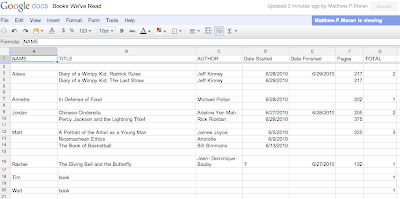
Highlights:
- Of my 4 initial invites to edit the doc, 3 of them are already using it, including the 2 targets.
- We took an emergency trip to 2 local libraries yesterday to stock up the family with family (reading) feud ammo.
- I crept upstairs at 12:30am last night and found my youngest sister reading near the end of her first book already. This morning when I checked she'd already updated that she finished the book and was on to the next one.
This is definitely happening again for my students next September!
Friday, June 25, 2010
How Was I As a Student?
Most public schools in the NYC-area closed yesterday or this morning. The private schools have been on vacation since the beginning of the month. Summer break is here.
The start of next year seems so far away, that I'm going to shift gears for a while and work less on plans and schemes and do more reflections. I have gotten a good education out of this past year and learned and developed a lot.
The challenge is to take the next few weeks and look back on what I've learned and get meta-cognitive about it.
Lately I've been thinking about how difficult it is to get students to match my expectations for them. I often find myself daydreaming back to when I was a student and wondering about how it was that my teachers, parents and role models taught me the standards that I've internalized. I have seen videotape of my teaching before and received feedback on my work as a teacher, but I'll never be able to see what I was like as a student. That's what I'd really want. To be able to see how I was taught, and how my peers were taught, and how we responded.
Until I have this information, or a real close proxy for it, I will be missing a great opportunity to get much better in preparation for next year.
Subscribe to:
Posts (Atom)