Showing posts with label reading. Show all posts

Tuesday, September 28, 2010

The Odyssey, Oral Storytelling and the iPad


Today I had problem: I have students who are going to spend the next month reading The Odyssey, a book which I failed to fully appreciate when I was a college student reading it for the first time. I wondered how the high school students are going to be able to a) read the book without relying on Sparknotes, Cliffnotes, or other summaries of the text and b) get more out of this than if they were to just read it to themselves and not comprehend a good fraction of the narrative.

Here's my solution: technology.

How I got there:
Fortunately, I have MP3 files of the audiobook of The Odyssey that I bought for my dad years ago. I had planned to read along with the story using the audiofiles in order to experience the story as its original audience did, by hearing it from an oral storyteller. I had originally thought about posting the files somewhere online where the students would be able to access them, but the Fair Use Policy doesn't feel like enough license to do that. Then, I thought about putting the files on CD for students to burn to their own hard drives, iPods, etc. Finally, I remembered how my school is lending me this iPad and how I haven't been sharing it enough with the office (how surprising!). So here's the new plan:
  1. Burn the audiofiles for all of The Odyssey onto the iPad.
  2. Download the same edition for iBooks.
  3. Lend out the iPad to teachers and students in the office when I am not around.
They can use it to curl up and read and listen to the text read aloud as they follow along. Presumably, hearing it performed will add more meaning than their straight internal narration with all of its stumbling for pronunciations of ancient Greek words and names. Then, we'll see if this is a better reading experience for any of them than the more traditional alternative.

I think it's crazy that it takes a very modern piece of hardware to inspire a teacher ask students to listen to an epic poem.

Addendum:
The NY Times had an article on how children may read more with access to e-readers.
I liked these stats:
About 25 percent of the children surveyed said they had already read a book on a digital device, including computers and e-readers. Fifty-seven percent between ages 9 and 17 said they were interested in doing so.
And:
Many children want to read books on digital devices and would read for fun more frequently if they could obtain e-books. But even if they had that access, two-thirds of them would not want to give up their traditional print books.

Thursday, July 8, 2010

How Can I Get My Young Reader to 10,000 Hours of Reading?


By now the advantages of practicing something for 10,000 hours are widely publicized. My summer vacation to visit my family has turned into an experiment to get my little sister to become a voracious reader. After she re-read a few favorite books she was ready for a real challenge: the Harry Potter series.

We picked up Harry Potter and the Sorcerer's Stone from the local library. After a quick practice read-aloud and the five-finger test we dove into reading HP together. The motivation was there, but it was definitely a challenge. The beginning of the book is filled with strange vocabulary and some British-English that is quite confounding for a young fledgling reader (YFR). But I realized that the great thing about her having picked this book was that if she came to love it, she could just go and go and go ... . At a total of a whopping 4,167 pages, the series puts YFR well along the path to the magic 10,000 rule.

I used to disparage the HP series since I didn't see how the books were any better than the highly entertaining movies. I have learned and changed my mind. Reading the HP books is big. 4,167 pages of anything is a huge investment of time and attention in our impatient society. It deserves special recognition. It's way more of an accomplishment than the participation awards we give out for playing on a team and it ranks up there with earning a rank in the Boy Scouts. So I've created my own HP Reading Certificate and passed them out to the first 3 HP readers I saw. See it here:
If you have read the complete series and would like your own certificate to prove it, leave your email in the comments and I will try to pass one on soon.

Tuesday, June 29, 2010

Our Family Feud

When I was in second grade our school had a program called Reading Around the World. It worked like this: students had reading sheets where they kept track of the books they read every night, parents signed off, and when the student returned to school their reading totals were updated with a marker on a giant colorful cartoon map of the country/world in the longest hallway in the school. I ate this up. I was either first or second in my class for the Reading Around the World totals, mostly because I wanted to earn the cool prizes that came with it, especially the little rubber sneaker erasers that were so coveted by my classmates.

Ever since then, I have yet to see a system that created such a strong focus on reading, although there are some great programs out there being used by some of the charters schools I've worked in. Let's just say if I ran a school, this would be my number one academic priority. Forget the tests, gimme the books!

Photo: Rachel Beth Polan

So when I came home to see my family and I asked my sisters what books they were reading and got embarrassed stares, I decided to do something.

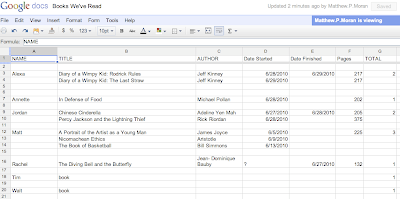
Our family is now keeping track of our reading and competing against one another using a GoogleSpreadsheet. Let's just say the results have been stunning so far.


Highlights:
  • Of my 4 initial invites to edit the doc, 3 of them are already using it, including the 2 targets.
  • We took an emergency trip to 2 local libraries yesterday to stock up the family with family (reading) feud ammo.
  • I crept upstairs at 12:30am last night and found my youngest sister reading near the end of her first book already. This morning when I checked she'd already updated that she finished the book and was on to the next one.
This is definitely happening again for my students next September!

Tuesday, June 22, 2010

Favorite Practice #2 - Snapping Good Read Alouds

First the problem with read alouds:

I used to be paralyzed with fear at the thought of teaching in the lowest grades of elementary school. I teach math - algebra, geometry, equations, exponents. I'm not equipped to teach reading.

Like many I have taught a single person how to read; I did the whole Hop on Pop/Cat in the Hat thing with my sister and would claim her as one of my earliest pupils. However, reading with one person is 1/1000th as hard as teaching a class of squirmy, distracted students.


That's why read alouds are great. 1) Teacher reads, everyone else follows along. 2) It mimics the benefits of the reading-learning relationship between a reader and his sister/child/friend/etc.

However, there are many problems with the read aloud.
  1. Can't tell who is listening at any given point in time.
  2. Don't know if they are reading or just listening.
  3. Hard to tell whether there is comprehension until its Q and A time.
So finally, Best Practice #2 goes to a second grade teacher at Achievement First Crown Heights for his use of a snapping good read aloud.

The simple method works like this:
  1. Teacher reads.
  2. Teacher pauses.
  3. Teacher snaps.
  4. All students reads the next word.
  5. Repeat steps 1-4.
  6. Q and A time.
This easily solves read aloud problems #1 and #2 above. #3 is trickier, but its a lot easier using this method than otherwise.

Now read alouds are a snap. And fun for the kids too.