Showing posts with label technology. Show all posts

Thursday, October 7, 2010

WCYDWT: Fare HIke

Reading the NY Times today I saw a blog post regarding the MTA's vote to raise the price for 30-day and weekly metro passes as well as individual fares. What caught my eye was that the article described one increase (for the 30-day passes) in terms of percent increase. That was all I needed.

Following the Meyer method, I got an image of the article and blacked out the percent increase answer for the students. I asked them to predict what the percent increase could be. We investigated the problem. I demonstrated how to find percent increase, which only a few of the students seemed to have learned before. Then, we checked our answer against a clean copy of the article that I printed later.

Overall, there was some learning and some excitement, but I can't help thinking that I could have done this better. What could I have done differently?

Before:

After:

Notes for next time:
  • Next time black out the answer in Keynote, then print. My students spent a ridiculous amount of time trying to read through the dark splotch that I made with my pen before making copies.
  • We tied in our steps for problem solving (Understand, Plan, Answer, Check) a bit too late. It would have really helped to direct their frustrations if we were introducing the structure earlier.
  • The guessing/estimating gets a little distracting because the students attempt to revise their guess at each stage in our problem-solving process. It needs to be stated more clearly that while we can keep revising the end is to have a solution, not a guess.

Tuesday, September 28, 2010

The Odyssey, Oral Storytelling and the iPad


Today I had problem: I have students who are going to spend the next month reading The Odyssey, a book which I failed to fully appreciate when I was a college student reading it for the first time. I wondered how the high school students are going to be able to a) read the book without relying on Sparknotes, Cliffnotes, or other summaries of the text and b) get more out of this than if they were to just read it to themselves and not comprehend a good fraction of the narrative.

Here's my solution: technology.

How I got there:
Fortunately, I have MP3 files of the audiobook of The Odyssey that I bought for my dad years ago. I had planned to read along with the story using the audiofiles in order to experience the story as its original audience did, by hearing it from an oral storyteller. I had originally thought about posting the files somewhere online where the students would be able to access them, but the Fair Use Policy doesn't feel like enough license to do that. Then, I thought about putting the files on CD for students to burn to their own hard drives, iPods, etc. Finally, I remembered how my school is lending me this iPad and how I haven't been sharing it enough with the office (how surprising!). So here's the new plan:
  1. Burn the audiofiles for all of The Odyssey onto the iPad.
  2. Download the same edition for iBooks.
  3. Lend out the iPad to teachers and students in the office when I am not around.
They can use it to curl up and read and listen to the text read aloud as they follow along. Presumably, hearing it performed will add more meaning than their straight internal narration with all of its stumbling for pronunciations of ancient Greek words and names. Then, we'll see if this is a better reading experience for any of them than the more traditional alternative.

I think it's crazy that it takes a very modern piece of hardware to inspire a teacher ask students to listen to an epic poem.

Addendum:
The NY Times had an article on how children may read more with access to e-readers.
I liked these stats:
About 25 percent of the children surveyed said they had already read a book on a digital device, including computers and e-readers. Fifty-seven percent between ages 9 and 17 said they were interested in doing so.
And:
Many children want to read books on digital devices and would read for fun more frequently if they could obtain e-books. But even if they had that access, two-thirds of them would not want to give up their traditional print books.

Sunday, September 19, 2010

It's 8:05 P.M., Your Homework is Late!

Following up on my previous post on how I want to stop grading, I thought it would be good to provide some notes from the field as we head in to our second full week.

  • I sent out a "Math Checkup" using a Google Form. This was a pretty quick and easy diagnostic assessment that I made using NYS Testing Program multiple choice questions. A few students had trouble opening the form either in their e-mail or through a hyperlink, but after a few days most everyone had figured it out. I now know a rough estimate of each student's proficiency and could figure out the value-add at the end of the year if I give a similar exam. I also know a few topics to cover early on that I may have skipped over. Oh, and did I mention that I can skip collecting exams, grading the answers and entering the data into Excel?
  • We have started to do nightly homework assignments also using Google Forms. When I gave out a quick survey at the end of this past week, I got the following results:
"The one thing that should change about this class is..."
"The homework" (1)

"The one thing that should NOT change about this class is..."
"The homework" (2)
Ever seen kids answer a survey and say that they didn't want the homework to change? And that one student is getting a paper copy printout tomorrow.
  • While the students are completing their homework in Google Forms, I come home from school everyday and check my Google account after dinner. I always get to see who has completed the assignment already and can think ahead to what we need to review in class the next day.
The next steps for this project:
  1. Reliability - This is an issue. Some kids have been reporting trouble opening the email or submitting their finished work. I think a few more test cases should help solve this.
  2. Confirmation - Everyday students have come in to class asking "Did you get my homework?" It's music to my ears! However, I'd like for them to know that I received their work before then so there is no anxiety. Currently, I've customized the confirmation note, but even this leaves them wondering if it even worked.
  3. Feedback - One possible solution to #2 is to give the students permission to view the results. This would be great because it could give them instantaneous feedback on whether they got it right or not. However, currently this would mean they could see everyone's answers. I need to make sure they can be trusted not to use that information for evil. I want to trust them, but we need to discuss this and maybe build up our group norms a bit. There is also the risk that they could cheat by seeing the answers then sending them to a friend. But that's why I love that time stamp feature that is built in. I wouldn't mind students submitting, checking and resubmitting. In fact, that would be the best. Video games good.

Monday, August 30, 2010

Next, I Will No Longer Teach My Class

At the end of my first year of teaching, I heard from another first year teacher, Mr. X., who taught a special education class with some really big challenges. He had some experience with technology and film production and so his fresh take on teaching was to:
  1. Record his lessons in advance, and play them during class time
  2. Work closely with his students who required the most personal attention during the time when the class learned via prepared video
Amazingly, this teacher was running his own focused Khan Academy in class. And then provided individualized special education service, while his lesson was being taught simultaneously. By him!


Now what does this have to do with me?

This year I am teaching a small class that needs a different approach to math. (Which I am fully intending to provide.) While I am teaching this class, I want to do the same thing that Mr. X. was doing. And I think, via a Technology PD session at my school, I've learned the way that I can do it.

Here's what I know already I can do with VT:
  • Post images
  • Connect audio and video to those images
  • Set up a slideshow presentation
  • Write on the slides/images with colored pens (Just like Khan!)
I don't yet know what my capacity limits are for this site though. Can I do a whole lesson? Can I do a week's lessons? For how many classes? Semesters? The whole year?

What else can I do with this? Anything better out there that I've been missing?

So excited for the potential to clone myself in the classroom!


Friday, August 27, 2010

Teachers Unite! Let's Stop Grading!


Teachers are amazingly talented professionals with a wide range of skills from delivering content instruction to all types of learners to offering support and consulting to troubled youths. But, nearly across the profession, one particular skill has way too much time being devoted to itself: GRADING.

I want to cut my grading time down to nothing. I might not make it all the way, but the closer I get the better I'll be at every other thing, from lesson planning to instruction to advising and on.

How Am I Going to Start:
  1. Watch YouTube
  2. Get together a team of dedicated teachers, who want to plan smarter and grade less.
  3. Try and try again until we succeed.

Who's with me?

Tuesday, June 29, 2010

Our Family Feud

When I was in second grade our school had a program called Reading Around the World. It worked like this: students had reading sheets where they kept track of the books they read every night, parents signed off, and when the student returned to school their reading totals were updated with a marker on a giant colorful cartoon map of the country/world in the longest hallway in the school. I ate this up. I was either first or second in my class for the Reading Around the World totals, mostly because I wanted to earn the cool prizes that came with it, especially the little rubber sneaker erasers that were so coveted by my classmates.

Ever since then, I have yet to see a system that created such a strong focus on reading, although there are some great programs out there being used by some of the charters schools I've worked in. Let's just say if I ran a school, this would be my number one academic priority. Forget the tests, gimme the books!

Photo: Rachel Beth Polan

So when I came home to see my family and I asked my sisters what books they were reading and got embarrassed stares, I decided to do something.

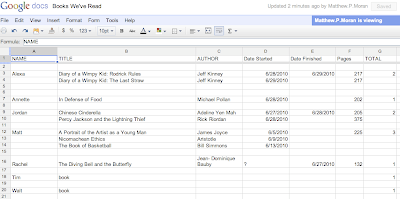
Our family is now keeping track of our reading and competing against one another using a GoogleSpreadsheet. Let's just say the results have been stunning so far.


Highlights:
  • Of my 4 initial invites to edit the doc, 3 of them are already using it, including the 2 targets.
  • We took an emergency trip to 2 local libraries yesterday to stock up the family with family (reading) feud ammo.
  • I crept upstairs at 12:30am last night and found my youngest sister reading near the end of her first book already. This morning when I checked she'd already updated that she finished the book and was on to the next one.
This is definitely happening again for my students next September!